Requirements
Requirements
Principles Authors of Scientific Publications Must Follow
The author (or team of authors) bears primary responsibility for the scientific novelty, reliability, and accuracy of the results presented, which implies adherence to the following principles:
Reliability of Results: Authors should present accurate and verifiable research results. Knowingly incorrect or falsified data and statements are unacceptable.
Originality and Proper Citation: Authors guarantee the originality of the submitted work. Any borrowed material must be properly referenced with mandatory indication of the author and the original source. Plagiarism in any form (including unattributed quotations, improper paraphrasing, and appropriation of others’ research results) is unethical and prohibited.
Acknowledgement of Contributions and Accurate Referencing: The contribution of all individuals and scientific works that influenced the research must be acknowledged. The manuscript should contain references to significant sources.
No Duplicate Submission/Publication: Authors must not submit to the journal a manuscript that is simultaneously under consideration by another publication, or that has been published previously. Submitting the same article to multiple journals at the same time is unethical.
Proper Authorship: All individuals who made a substantial contribution to the study design, data acquisition, results, and manuscript preparation should be listed as co-authors. Listing individuals who did not participate in the research is unacceptable.
Co-author Consent: The submitting author must ensure that all co-authors have approved the final version of the manuscript and its submission to the journal.
Correction of mistakes: If significant mistakes or inaccuracies are identified during review or after publication, the author must promptly inform the editorial office and cooperate in making corrections (including, if necessary, issuing a correction or retraction).
Funding and Conflicts of Interest: If the research was funded, the author should disclose the funding source and, if relevant, describe its role in conducting the study and/or preparing the manuscript. Any potential conflicts of interest should also be declared.
The journal accepts articles only in English.
Manuscripts should be submitted by email to geologiya.kz@gmail.com.
Along with the text of the article, authors must submit two signed reviews (an internal review from the organization where the author(s) work, and an external review from another organization), as well as a page with the authors’ signatures.
The editorial board accepts articles in the following fields of science: geology, hydrogeology, geography, mining engineering, and chemical technologies of oil, gas, and metals.
- The corresponding author is marked with an asterisk (*).
- One author may publish only one article per issue, including co-authorship.
- The number of authors per article is no more than five (5).
- Self-citation (authors citing their own works) must not exceed 20% of the reference list.
- Authors bear responsibility for the content of the article. The views of the editorial bodies may not coincide with those of the author(s).
- Articles are published in the order of readiness; the editorial office may manage the queue according to sections and issue themes and may publish, out of turn, manuscripts of significant scholarly interest.
- The Editorial Board reserves the right to accept or reject a manuscript at any stage of the editorial and publishing process.
- To prevent academic plagiarism, the editorial office conducts mandatory checks for plagiarism and the use of AI tools.
Length and Language Requirements
- Recommended length of the main text (from “Introduction” to “Conclusion”): 4,000–7,000 words.
- Abstract and keywords should be provided in three languages (Kazakh/Russian/English).
- All tables, figures, and formulas should be numbered.
Technical Formatting (Word/RTF)
- File format: Microsoft Word / RTF
- Font: Times New Roman
- Line spacing: single
- Margins: 2 cm on all sides
- First-line indent: 1 cm
- Alignment: justified
Font sizes:
- Authors, affiliation, article title, abstract, keywords, main text: 12 pt
- Full author information: 9 pt
- Tables, figures, and captions: 9 pt
- References: 9 pt
Additional note: Before submission, please verify correct spacing after punctuation marks (especially in the reference list).
First Page Layout
- IRSTI code (left aligned): https://grnti.ru/
- Author details: initials and surname; degree/title; position; organization; city; country; ORCID; e-mail.
- The corresponding author is marked with * (e-mail and mobile phone number should be provided).
- Article title:
- in three languages (EN/KZ/RU);
- bold, UPPERCASE, centered;
- no more than 14 words.
Article Structure
- Title – no more than 14 words
- Abstract (EN – up to 300 words / KZ-RU – 200–250 words)
- Keywords (EN/KZ/RU – 5–7 words/phrases)
- Acknowledgements / Funding (in English)
- Introduction
- Literature Review
- Materials and Methods
- Results
- Discussion
- Conclusion
- Conflict of Interest (if applicable)
- References
Abstract: 200–250 words in Kazakh and Russian; up to 300 words in English. The structure and content must be identical in all three languages.
Recommended abstract structure:
- problem statement and relevance;
- methods;
- key findings/results;
- practical application of the results.
Keywords: 5–7 words/phrases in three languages.
Tables and Figures
- Figures and tables are placed within the text and numbered: “Figure 1 – …”, “Table 1 – …”.
- Total volume of illustrative material (tables/figures/charts, etc.) should not exceed 20% of the article (in special cases-up to 30%).
- Captions and elements must be readable; of sufficient quality for printing/publication.
Tables should be created using Microsoft Word table tools., they should be numbered and referenced in the text. The table title is placed left-aligned above the table, without first-line indentation, with line spacing before and after the title. Table text is formatted in 9 pt. A note indicating the source must be included as the last continuous line within the table.
Example:
Table 1 – Table Title
|
Name |
Name |
Name |
|
А |
P |
105 |
|
В |
T |
273 |
|
Note: Compiled by the author(s) based on the source (…). |
||
Figures
All figures should be numbered with Arabic numerals (1, 2, …). All photographs, diagrams, charts, and schemes are treated as figures. Labels and symbols must be clearly explained either in the caption or in the legend (as part of the figure). Figures should be provided in Word as grouped objects. Figures should be created without fills, using black outlines; internal text - 9 pt. Figures should be placed as close as possible to their first mention in the manuscript. A note is provided after the figure title.
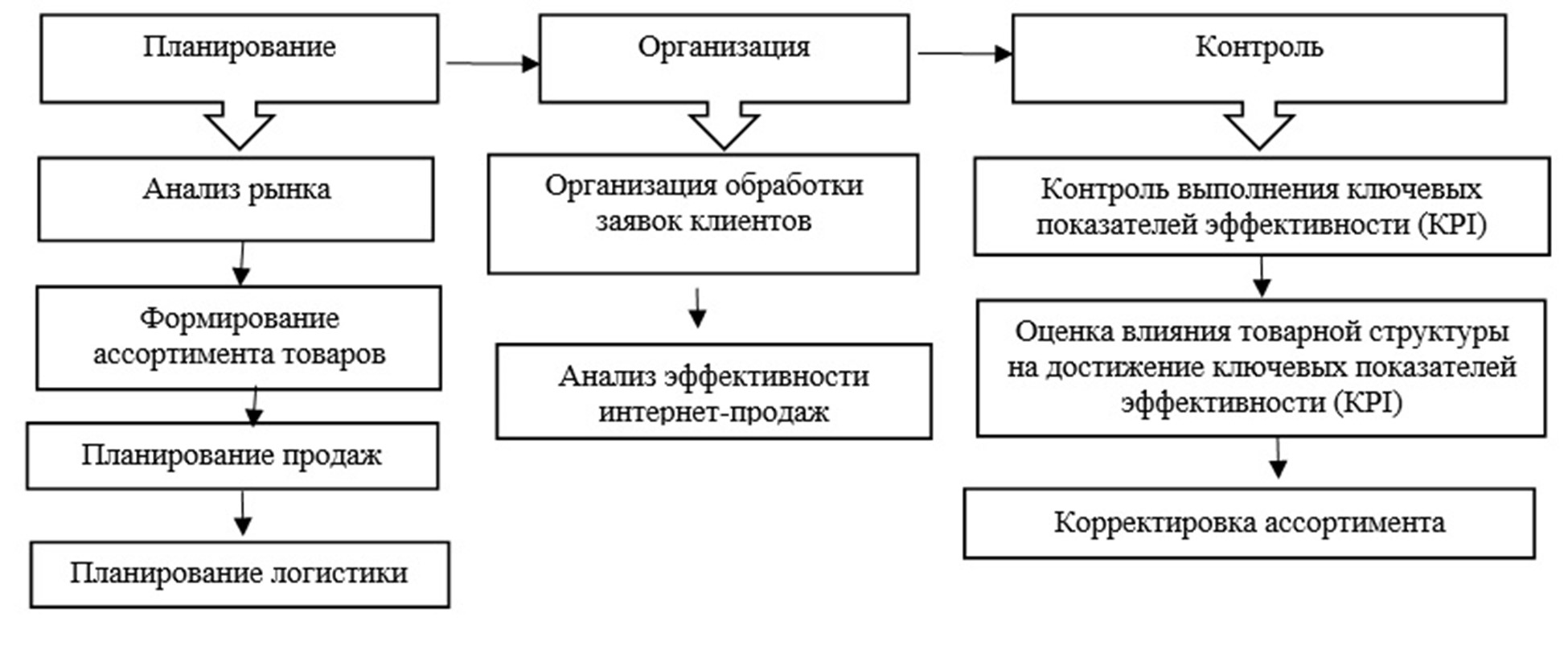
Figure 2 – Structural and Logical Diagram of the Management Framework for the Product Assortment of an Online Store
Note: Compiled based on the source (…..).
Equations
Equations and formulas should be prepared using MathType and numbered consecutively with Arabic numerals in parentheses, aligned to the right margin of the page. They must also be separated from the surrounding text by one blank line (one line space) above and below.
 (1)
(1)
where:
 – description of symbols;
q – description of symbols;
λ – description of symbols;
Referencing and In-Text Citations
Reference List Requirements
- The reference list must include 20-25 sources, with at least 50% being international sources and/or sources indexed in international databases.
- It is recommended to include 10 sources published within the last 3–5 years, including Scopus/Web of Science.
- DOIs are mandatory for all journal articles, where available.
- Self-citation limit: no more than 20% of the reference list.
In-Text Citations
Citations must follow the author–date format:
- (Auezov, 1991)
If an author has multiple works published in the same year:
- (Porsev, 2020a), (Porsev, 2020b)
References (English Only)
The References section should be provided in English only and formatted according to APA style. English-language sources must be presented in their original form.
If the original source is in Kazakh or Russian, format it as follows:
Author(s) → (Year) → transliterated title [English translation in square brackets] → source/publication details (in English) → (in Russian)/(in Kazakh).
Example:
Kornilov O.A. (2011). Jazykovye kartiny mira kak proizvodnye nacionalnyh mentalitetov [Linguistic worldviews as derivatives of national mentalities]. Moscow: KDU, 350 p. (in Russian).
Manuscript Submission Workflow
- Technical screening — up to 1 month (initial editorial response).
- Plagiarism and AI-use check via StrikePlagiarism.com:
- Originality ≥ 85%
- Similarity 1 ≤ 20%
- Similarity 2 ≤ 5%
If thresholds are exceeded, the editorial office acts in accordance with COPE In cases of minor exceedances, the author may revise the manuscript and undergo a re-check.
- Based on review results: acceptance / revision / rejection.
- A revised manuscript should be returned within 5 business days. If no response is received, the submission is rejected and removed from further consideration.
AI Use Policy
The journal permits the use of AI tools only as auxiliary instruments (language editing, literature search, statistical calculations, visualization) under the author’s full control. Any use of AI must be disclosed in the manuscript (e.g., in the “Methods” section), specifying the tool name, version, and purpose. AI tools cannot be listed as authors. Authors bear full responsibility for the accuracy, originality, and integrity of the text.
Failure to disclose AI use or violations related to plagiarism may result in sanctions, including rejection of the manuscript and a 3-year submission ban.
Plagiarism Sanctions
Plagiarism in any form is unacceptable. Manuscripts containing proven plagiarism exceeding 50% or involving text manipulation are rejected, and the author(s) are prohibited from submitting manuscripts to the journals of the “Central Asian Academic Research Center” for three (3) calendar years (both as authors and co-authors).
Publication Schedule and Submission Deadlines
- The journal is published six times per year (once every two months).
- Issues are posted on the website by the end of February, April, June, August, October, and December.
- The maximum manuscript processing time is 1–3 months.
Article example: Download